Front-of-house staff put a polo through more in a week than most office wearers manage in a season: eight-hour shifts on hard floors, repeated commercial laundering, brushes against chair backs and bus tubs, and the sweat of a hot service line. Choosing a custom polo for a restaurant or hotel team is less about the logo and more about picking a fabric and cut that still looks presentable after fifty washes. This guide walks through the specification decisions that actually matter for hospitality, roughly in the order they come up when you place an order.
What a shift on the floor demands from the fabric
A restaurant polo has a different job than a corporate golf-day shirt. It is a uniform worn for long stretches, laundered on a schedule, and seen at close range by paying guests. That means durability, stain behavior, and a consistent look across a dozen bodies matter more than a premium hand-feel. Two staff members in the same shirt should still look like they work for the same place after three months, which pushes toward colorfast synthetics and tightly knit, snag-resistant fabrics rather than the soft fashion cottons that fade and pill. Before you compare colors or decoration, it helps to decide what failure looks like for your team: a faded collar, a pulled loop on the sleeve, a shirt that reads as damp during a rush. Each of those traces back to a fabric decision.
Fabric weight and knit: reading the GSM number
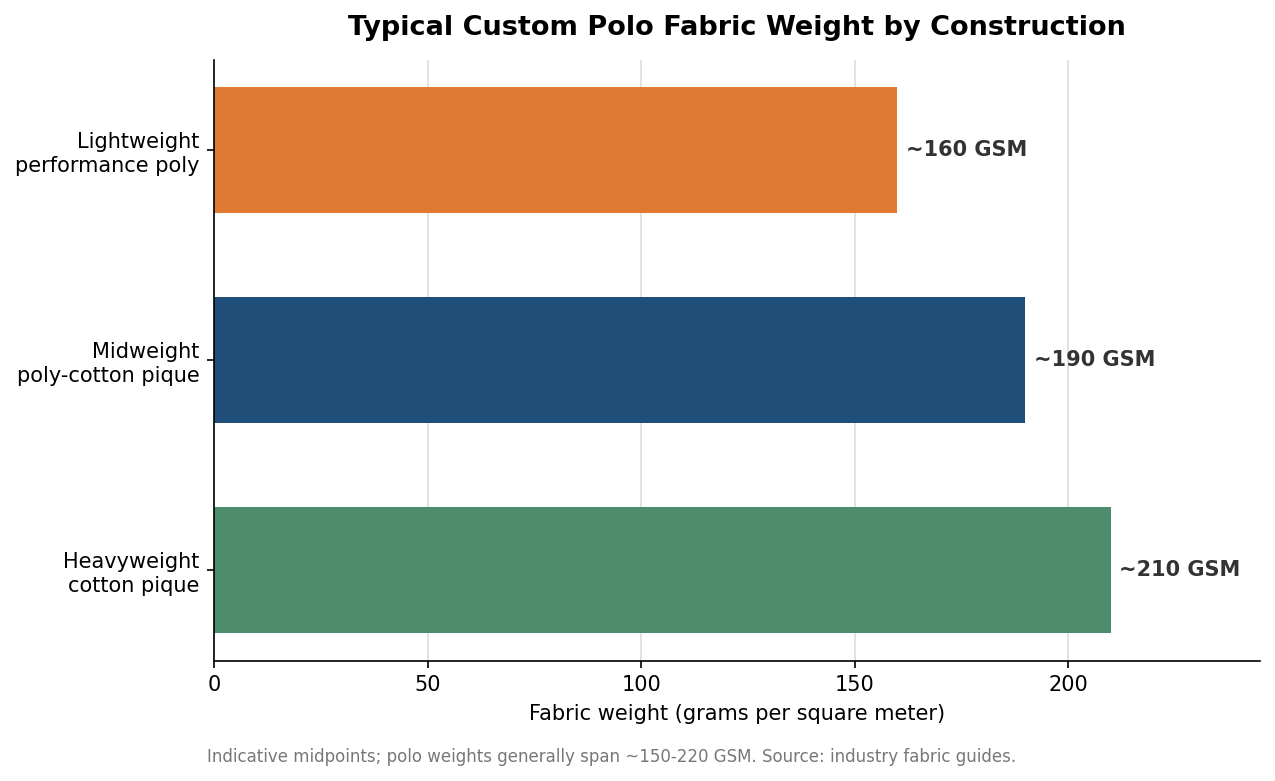
The single most useful number on a polo spec sheet is fabric weight, usually given in grams per square meter. Most polos fall between roughly 150 and 220 GSM. Lighter fabrics near 150 to 170 GSM breathe better and suit warm dining rooms and patios; heavier fabrics around 200 to 220 GSM hold their shape, hide the body underneath, and generally survive more wash cycles. For hospitality, a midweight in the 180 to 200 GSM band is a sensible default: enough structure to look crisp through a shift, not so heavy that a server overheats near the pass.
Knit structure matters as much as weight. Pique is the textured, waffle-like knit most associated with polos, and it adds breathability while hiding minor snags and wrinkles, which is why it dominates uniform programs. Jersey knit is smoother and softer, closer to a t-shirt, but it shows creases and wear sooner. For a working uniform that will be washed constantly, pique is usually the safer specification even though jersey feels nicer new.
Moisture, snags, and stains in a working environment
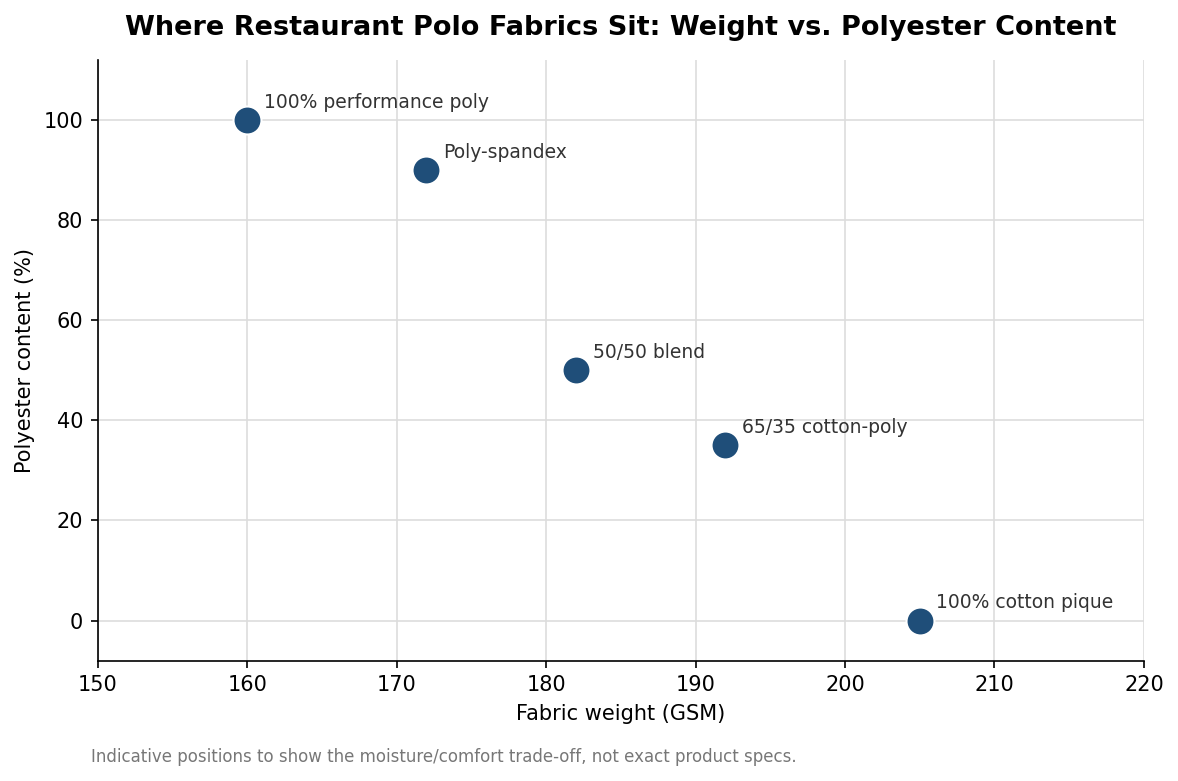
Front-of-house work is sweaty, and how a fabric handles moisture is where cotton and polyester genuinely diverge. Performance polyester and poly-rich blends move moisture along micro-channels in the knit so it evaporates, which keeps a shirt from looking soaked during a rush. Cotton absorbs and holds that moisture instead. That single property is why many hospitality programs choose 100% polyester or a polyester-dominant blend over pure cotton, despite cotton’s softer feel against the skin.
Snag resistance is the quieter concern. Servers brush against table edges and chair backs all day, and one pulled loop reads as sloppy from across a dining room. Tightly knit polyester pique resists snags better than open cotton knits, and several uniform-specific fabrics are sold as “snag-free” for exactly this reason. Stains and colorfastness close the loop: polyester holds dyed color through repeated hot washes and the occasional bleach touch-up far better than cotton, which fades at the collar and cuffs first.
Blends split the difference. Cotton-poly mixes at 50/50, 60/40, or 65/35 give more comfort than pure poly and more colorfastness and wrinkle resistance than pure cotton. Expect roughly 2 to 3 percent shrinkage from any cotton-containing shirt over its first few washes, and size up accordingly. Manufacturers generally advise washing below about 104°F (40°C) to protect both the fibers and the embroidery, but commercial laundries often run hotter, which is one more argument for polyester in a uniform that will be laundered off-site.
Decoration, sizing, and reordering across a rotating staff
Embroidery is the standard decoration for hospitality because it survives washing better than most prints and reads as more finished up close. A left-chest logo typically sits about 3.5 to 4 inches wide and lands a few inches below the collarbone. On lighter fabrics under roughly 170 GSM, a very dense stitch count can pucker the shirt, so a backing stabilizer and a slightly simplified logo help the finish stay flat. If your logo has fine text or gradients, ask for a stitched sample on the actual garment before committing the full run.
Sizing across a mixed staff is where uniform orders most often go wrong. Rather than guessing, order a size spread and offer both a standard and a ladies’ cut so the shirt fits the whole team without anyone swimming in fabric or straining a placket. Keeping a small run of sample sizes on hand for new hires to try on saves a surprising number of exchanges. Reordering is the step buyers forget at the first order. Hospitality turnover is high, so you will reorder within months, and matching the original exactly depends on writing down the garment style number, the color name, the thread colors, and the logo placement. Lock those in when you approve the first run.
Lead times for decorated apparel are commonly one to two weeks for a standard order once artwork is approved, though that is indicative and stretches with larger quantities and busy seasons. Decorated polos in bulk tend to land somewhere in the range of roughly $15 to $35 per shirt depending on garment quality, decoration, and order size, so treat any single quote as a starting point rather than a fixed rate. Building a small buffer of spare shirts into the first order is the cheapest insurance against putting a new server on the floor in a shirt that does not match the rest of the team.
Leave a Reply