A custom polo almost never fails at the logo. It fails at three unglamorous places that no one checks on the sample: the collar starts to curl, the surface goes fuzzy with pilling, and the body shrinks a size after a few hot washes. A staff shirt can carry perfect embroidery and still look tired within a month if the blank underneath was chosen for price alone. The encouraging part is that all three problems are specifiable before you order. This guide covers what causes collar curl, pilling, and shrinkage, and the concrete specs that keep a custom polo looking sharp through a full season of wear and washing.
Why collars curl, and how to spec against it
The collar is the first thing a curling problem shows up on, and it is usually a construction issue rather than a care issue. A flat-knit collar that is knitted to shape with proper tension holds its form far better than a collar simply cut from body fabric, because the knit structure builds in stability at the edges. Weight matters too: a very light, thin collar has little body to resist rolling, while a slightly heavier collar sits flat under its own structure. Some quality blanks add a subtle interlining or a stabilizing finish at the collar and placket to lock the shape in.
When you specify, ask whether the collar is flat-knit or self-fabric, and favor flat-knit for anything worn as a uniform day after day. Care compounds the choice: high-heat drying is what turns a borderline collar into a permanently curled one, so even a well-built collar benefits from being hung or laid flat to dry. If a program has already bought curling polos, collar stays and a careful press recover some of it, but the durable fix is buying the right collar construction the first time.
Pilling: the fuzz that ages a uniform
Pilling is the small ball of tangled fiber that forms where a fabric rubs against itself or a bag strap, and it reads as wear even when the garment is otherwise sound. Two things drive it: fiber type and knit tightness. Short-staple fibers work loose and tangle more easily, which is why some cotton-polyester blends are notorious pillers, the cotton fuzzes up and the stronger polyester holds the pills on instead of letting them fall away. Tighter knits like a well-made pique give fibers less room to migrate, so they pill less than a loose jersey. Combed or ring-spun cotton, where the short fibers have been removed, also resists pilling better than a coarser open-end yarn.
To specify against pilling, lean toward a tight pique knit, ask whether the cotton is combed or ring-spun, and be cautious with mid-ratio cotton-poly blends worn under backpacks or aprons. Performance polos built from filament polyester, the kind used in athletic knits, tend to resist pilling well because there are no short fiber ends to tangle. On the care side, washing inside out on a cool cycle reduces the surface abrasion that starts pills in the first place.
Shrinkage: cotton moves, polyester barely does
Shrinkage is where fiber choice shows up most dramatically, and it is the fastest way a uniform stops fitting. Cotton relaxes and shrinks when heat and agitation release the tension locked into the yarn during knitting, while polyester is thermally stable and barely moves. As a rough guide, an untreated 100% cotton polo can lose on the order of three to five percent after washing, enough to drop a size in practice, while a 100% polyester performance polo shrinks almost imperceptibly. Blends land in between in proportion to their cotton content.
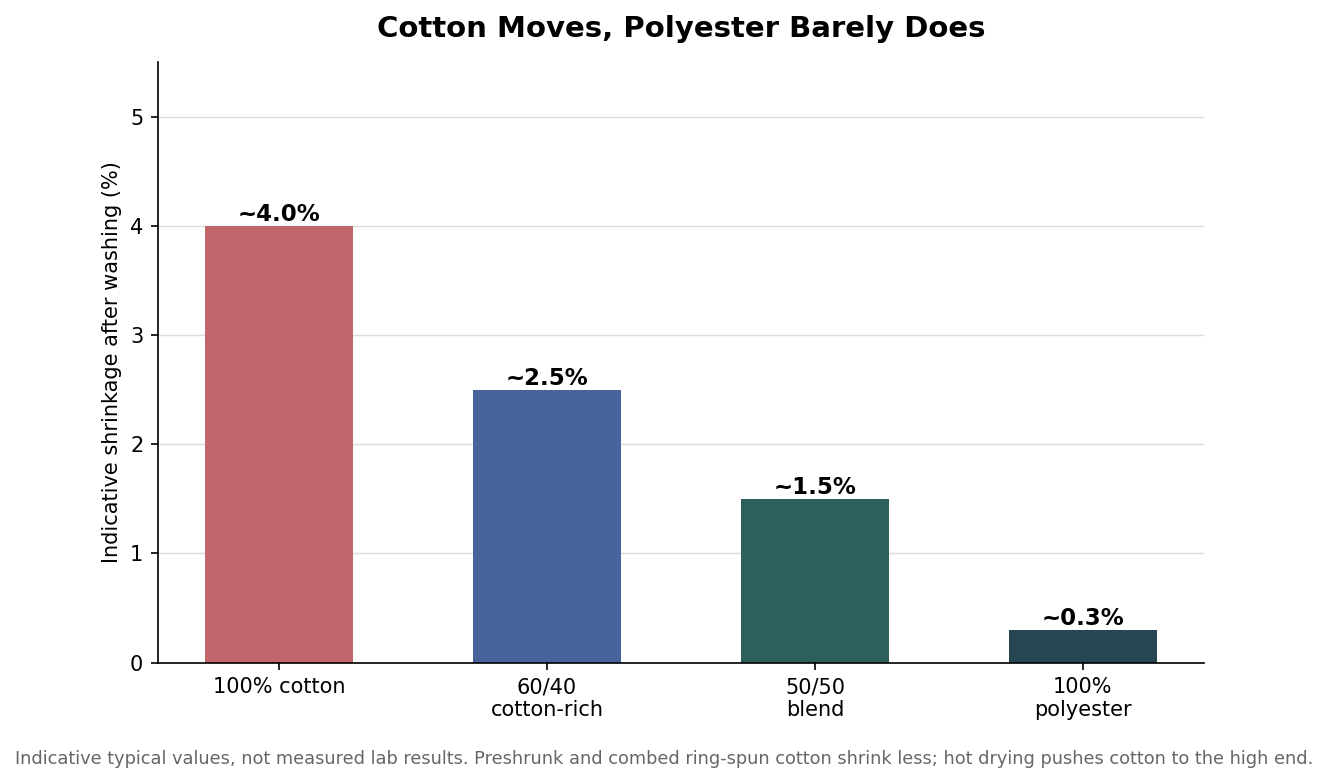
These are indicative figures rather than lab measurements, and two specifications move them. Preshrunk or compacted cotton has already taken most of its shrinkage before it becomes a garment, and combed ring-spun cotton behaves more predictably than coarser yarn. If you are buying cotton or a cotton-rich blend for a sized program, ask whether the fabric is preshrunk, and build your size run with that in mind. If consistent fit across dozens of people matters more than hand-feel, a higher-polyester blend removes most of the shrinkage variable entirely.
Reading the blank before you buy
Every durability property above traces back to what the polo is made of, so the fiber content line on a blank’s spec sheet tells you most of what you need to know before a sample even arrives. A 100% cotton pique will feel natural and breathable but move the most in the wash and pill if the yarn is coarse. A performance polyester knit will hold its size and resist pilling but feel more technical. Blends trade between the two.
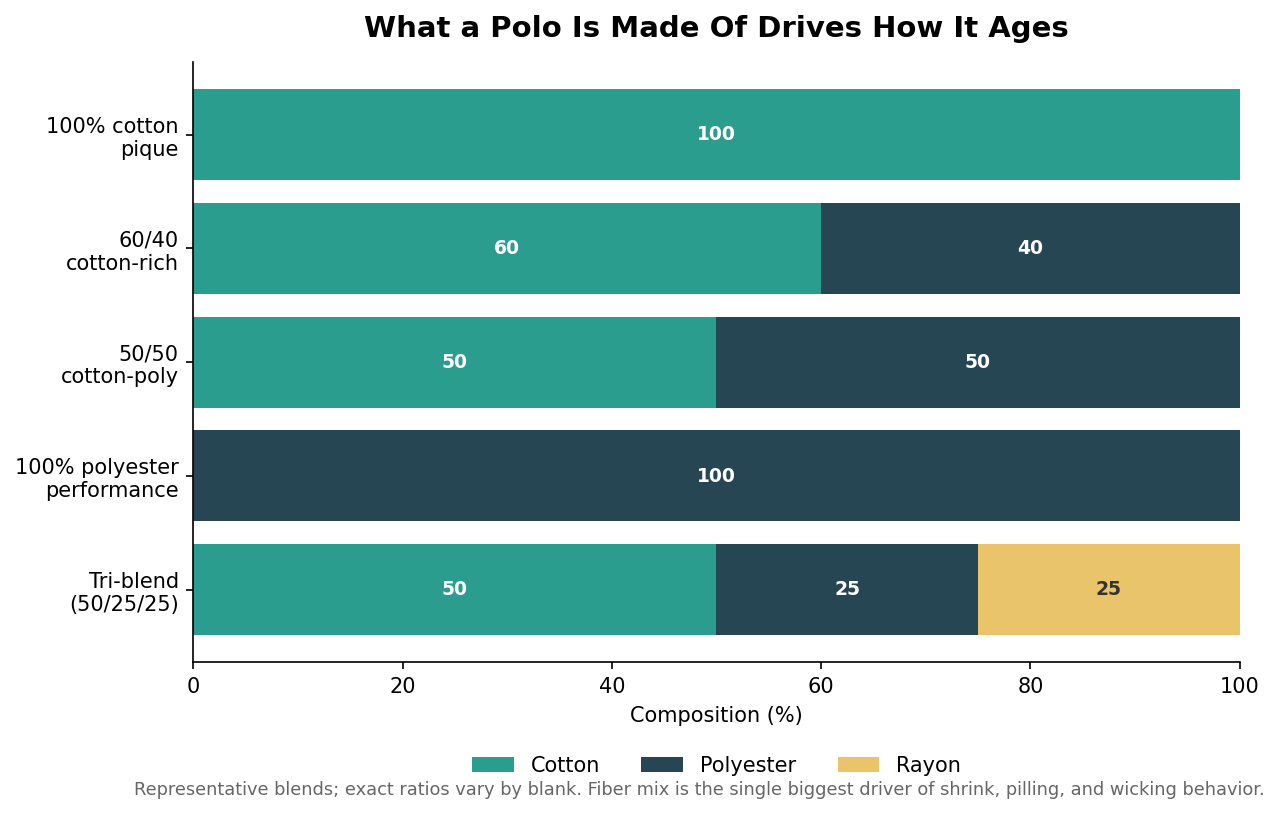
It helps to look at real blanks rather than abstractions. The catalog here spans exactly this range: cotton-forward pique options like the AS Colour Chad alongside performance-knit polos such as the Nike Dri-FIT NKDC1963 and Sport-Tek T474, and broad-size workhorses like the Port Authority K540 that runs from XS all the way to 6XL for programs that have to fit everyone. The right pick depends on the job. Choose a cotton pique when comfort and a classic hand lead and you can manage wash care; choose a performance polyester when size stability across a large team and low pilling matter more; and check the size range early, because a program that needs 5XL or 6XL has fewer blanks to choose from and should confirm availability before falling for a style.
Care that protects the spend
Even the best-specified polo lasts longer with a little care guidance passed to whoever wears it. Wash cool and inside out to limit both shrinkage and surface abrasion, skip high-heat drying in favor of hanging or laying flat, and keep embroidered polos away from the hottest dryer settings, since heat is hard on both the garment and the stitching. None of this is demanding, but a one-line care note handed out with a uniform order noticeably extends how long the set looks new, and it costs nothing to include.
Specifying for the long haul
Put the three levers together on your order rather than leaving them to chance. Ask for a flat-knit collar on anything worn daily, favor a tight pique in combed or ring-spun cotton, or a filament performance polyester, to hold off pilling, and match fiber content to how much shrinkage and fit variation you can tolerate, confirming preshrunk cotton where fit is critical. Then request a sample and, ideally, wash it a few times the way it will really be laundered before committing to a full run. Spend the extra attention on the blank, not just the logo, and the polo still looks like a uniform worth wearing after the fiftieth wash instead of the fifth.
Leave a Reply